
August 2026
Intern Spotlight: Majed Fitaihi
Wanting to get start-up experience under his wing, Majed joined Holly and built our GTM-dashboard from end-to-end.
Read More
.png)
June 17, 2026
A first-of-its-kind look at AI adoption across 12 government HR workflows
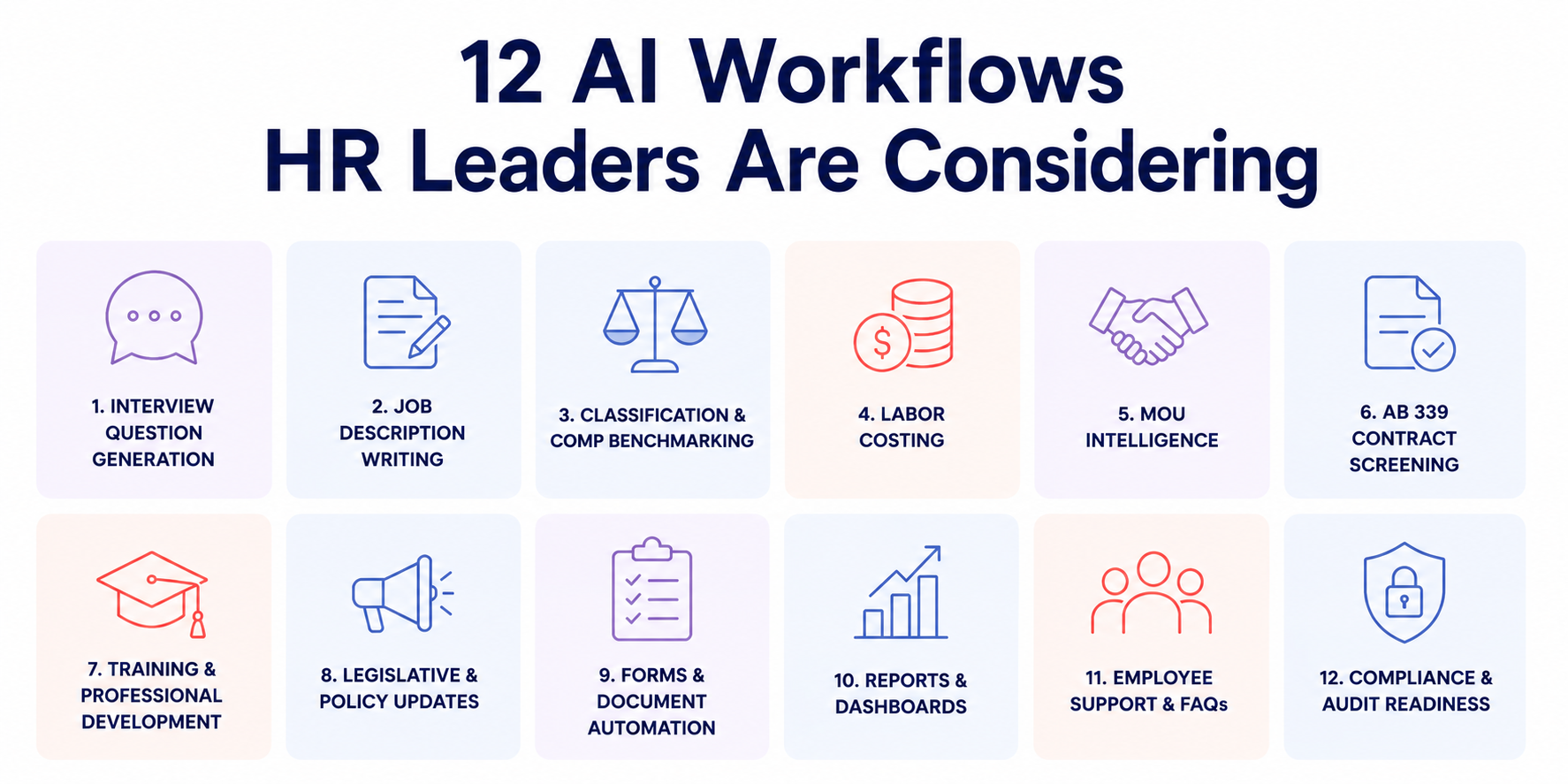
We've spent a lot of time in rooms full of government HR professionals and when we ask their thoughts on AI, it’s almost always the same: their interest is real, but nobody's sure where to start, what to trust, or what's actually worth trying. So in April 2026, we used the opportunity to survey folks at the NorCal Public Sector HR Conference in Sand City. We asked HR leaders across Northern California about 12 common workflows: are you already using AI here, interested in trying it, or holding back? Here's what we learned:
Across 9 of the 12 workflows, more people said they were interested in using AI than were already doing it. Where we’re seeing highest adoption are in workflows with a general-purpose chatbot that can handle passably well. But where people have high interest but low adoption are the ones that require government-specific knowledge including costing proposals against bargaining unit structures, interpreting MOUs that run over 100 pages, screening contracts against class specs under a regulatory deadline. The tools people want don't exist yet, or at least haven't made it into their hands; that’s huge!
Interview question generation leads at 62% already using it, with job description writing close behind at 46%. Classification and comp benchmarking is the more interesting number: 69% interested, 23% already using, and a 92% positive sentiment score among the teams that have tried it. That's the highest of any workflow in the survey, and the teams doing it are running continuous benchmarking against peer agencies and producing audit-ready output.
A few workflows stood out for having almost no adoption despite strong interest: Labor Relations and Labor Costing with 77% interested and 8% using; AB 339 Contract Screening with 69% interested and 0% using; Training and Professional Development came in at 69% interested and 8% using. The write-in responses confirmed the pattern: desk audits, recall studies, MOU interpretation, FMLA forms, and staff reports. Every unprompted suggestion was language-heavy, structured, and repeatable.
Almost no one is interested in involving AI in hiring or disciplinary decisions: Employee Relations and Investigations drew 77% cautious responses; Candidate Screening drew 69% and Recruiting drew 54%. Those instincts are correct since California, Illinois, Colorado, and the EU are all actively regulating exactly these workflows. The right call is to use AI on the structured work around those decisions and keep humans on the decisions themselves.
If you haven’t yet started on your AI journey, we suggest starting with classification and comp benchmarking, AB 339 contract screening, and labor costing and MOU intelligence. It’s got high interest, low current adoption, and low regulatory risk: a perfect starting point. For those farther along in their journey we’re keeping our eye on (and working on!): continuous comp monitoring, auto-tracking legislative updates as AI law evolves, and AI support for first-time supervisors. These came up repeatedly in write-in answers and don't have good solutions yet.
Holly's State of AI Adoption in Government HR: NorCal Edition covers all 12 workflows with the full data, breakdowns by category, and the complete write-in responses from conference attendees.
%20(1).webp)
Request a personalized demo to see how Holly works with your actual job classifications and comparators (or that of a peer).